Author and Editor

Dr. Roger Sanjek’s Books
The Future of Us All
Roger Sanjek
Published by Cornell University Press
Print Length: 400 pages
Publication Date: October 15, 1998
ISBN: 978-0801434518
Before the 21st century is out, Americans of African, Asian, and Latino ancestry will outnumber those of European origin. In the Elmhurst-Corona neighborhood of Queens, New York City, the transition occurred during the 1970s, offering an early look at the future of urban America as it immerses us in Elmhurst-Corona's social and political life from the 1960s through the 1990s.
First settled in 1652, by 1960 Elmhurst-Corona was a mix of Germans, Irish, Italians, and other "white ethnics." In 1990 this population made up less than one fifth of its residents; Latin American and Asian immigrants and African Americans comprised the majority. The Future of Us All focuses on the combined impact of racial change, immigrant settlement, governmental decentralization, and assaults on local quality of life which stemmed from the city's 1975 fiscal crisis and the policies of the city's mayors. The book examines the ways in which residents —in everyday interactions, block and tenant associations, houses of worship, small business coalitions, civic rituals, incidents of ethnic and racial hostility, and political struggles against overdevelopment, for more schools, and for youth programs—forged alliances across lines of race, ethnicity, and language.
From the telling local details of daily life to the larger economic and regional frameworks, this book chronicles a neighborhood's transformation as a precursor to what other communities across America will be grappling with in the coming decades.
Fieldnotes: The Makings of Anthropology
Edited by Roger Sanjek
Published by Cornell University Press
Print Length: 312 pages
Publication Date: June 28, 1990
ISBN: 978-0801424366
Thirteen distinguished anthropologists describe how they create and use the unique forms of writing they produce in the field. Sanjek discusses the fieldnote practices of founding figures Frank Cushing, Franz Boas, W.H.R. Rivers, Bronislaw Malinowski, and Margaret Mead. He also analyzes field writings in relation to writing ethnographies.
Unique in conception, this book contributes importantly to current debates on writing, texts, and reflexivity in anthropology.
Gray Panthers
Roger Sanjek
Published by the University of Pennsylvania Press
Publication Date: February 28, 2012
Print Length: 320 pages
ISBN: 978-0812203516
Roger Sanjek examines Gray Panther activism over four decades. Here the inner workings and dynamics of the movement emerge: the development of network leadership, local projects and tactics, conflict with the national office, and the intergenerational political ties that made the group unique among contemporary activist groups.
Part ethnography, part history, part memoir, Gray Panthers draws on archives and interviews as well as the author's thirty years of personal involvement. With the ongoing retirement of the baby boomers, Sanjek's book will surely inform the debates and discussions to follow – on retirement, health care, and many other aspects of aging in a society that has long valued youth above all.
eFieldnotes: The Makings of Anthropology in the Digital World
Edited by Roger Sanjek and and Susan W. Tratner
Published by the University of Pennsylvania Press
Publication Date: August 12, 2015
Print Length: 312 pages
ISBN: 978-0812292213
Sixteen distinguished scholars address the impact of digital technologies on how anthropologists do fieldwork and on what they study. With nearly three billion Internet users and more than four and a half billion mobile phone owners today, and with an ever-growing array of electronic devices and information sources, ethnographers confront a vastly different world from just decades ago, when fieldnotes produced by hand and typewriter were the professional norm.
Reflecting on fieldwork experiences both off- and online, the contributors survey changes and continuities since the classic volume Fieldnotes: The Makings of Anthropology, edited by Roger Sanjek, was published in 1990. They also confront ethical issues in online fieldwork, the strictures of institutional review boards affecting contemporary research, new forms of digital data and mediated collaboration, shifting boundaries between home and field, and practical and moral aspects of fieldnote recording, curating, sharing, and archiving.
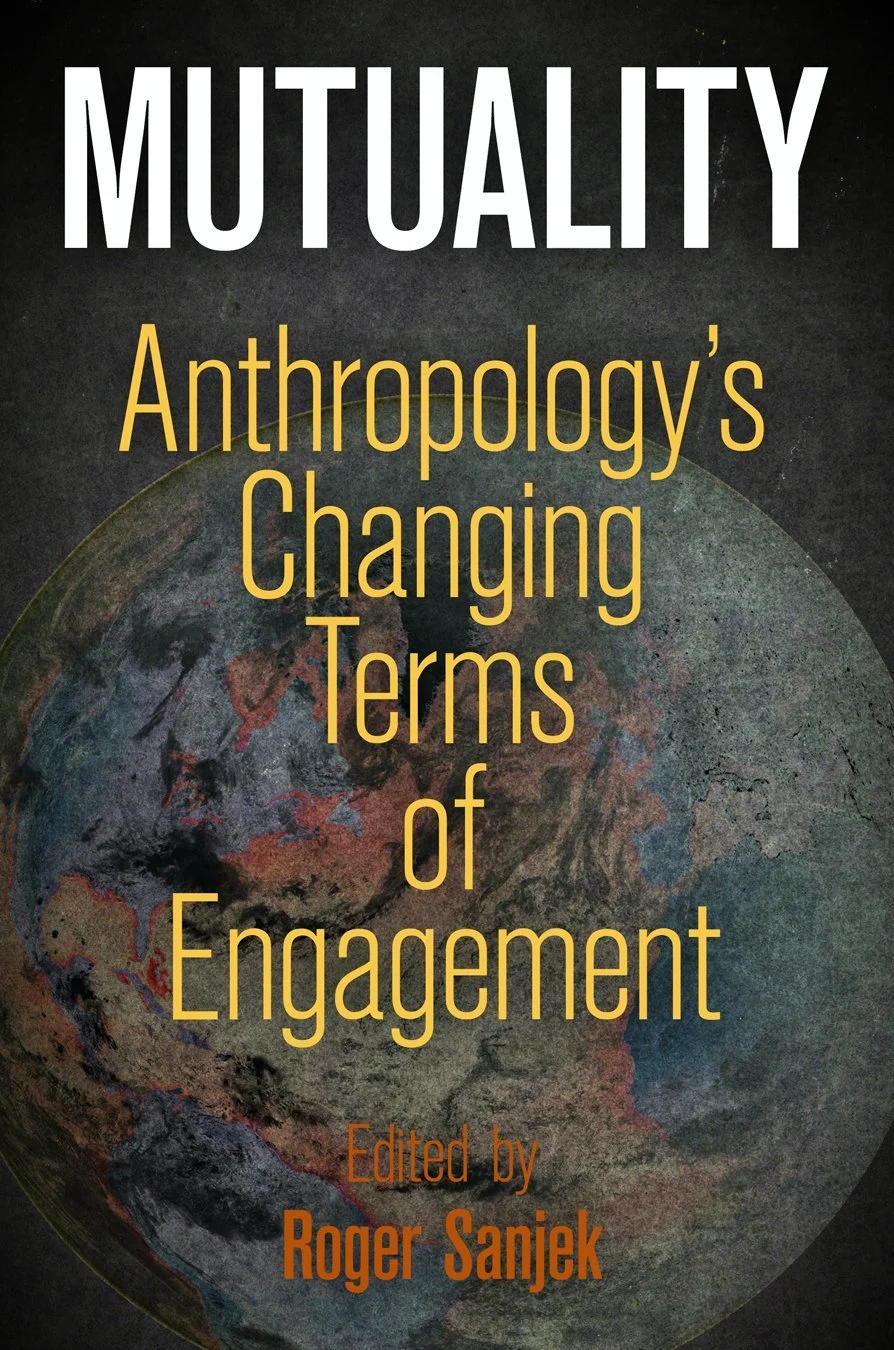
Mutuality: Anthropology’s Changing Terms of Engagement
Roger Sanjek
Published by the University of Pennsylvania Press
Publication Date: November 11, 2014
Print Length: 383 pages
ISBN: 978-0812290318
Why do people do social-cultural anthropology?
Beyond professional career motivations, what values underpin anthropologists' commitments to lengthy training, fieldwork, writing, and publication?
Mutuality explores the values that anthropologists bring from their wider social worlds, including the value placed on relationships with the people they study, work with, write about, and write for, and communicate with more broadly.
In this volume, seventeen distinguished anthropologists draw on personal and professional histories to describe avenues to mutuality through collaborative fieldwork, community-based projects and consultations, advocacy, and museum exhibits, including the American Anthropological Association's largest public outreach ever—the RACE: Are We So Different? project. Looking critically at obstacles to reciprocally beneficial engagement, the contributors trace the discipline's past and current relations with Native Americans, indigenous peoples exhibited in early 20th-century world's fairs, and racialized populations.
Deeply personal as well as professionally astute, Mutuality sheds new light on the issues closest to the present and future of contemporary anthropology.
Race
Edited by Steven Gregory and Roger Sanjek
Published by Rutgers University Press
Publication Date: November 1, 1994
Print Length: 420 pages
ISBN: 978-0813521091
“What unites these essays is a common focus on the ‘social construction’ of racial categories and a desire to expose the exercise of racism and its intersection with other forms of social domination such as class, gender, and ethnicity . . . “
Fascinating.”—Multicultural Review
“The coming together of theoretical, multiethnic, and ‘on-the-ground’ perspectives makes this book a particularly valuable contribution to the discourse on race.”
—Paula Giddings
Ethnography in Today's World: Color Full Before Color Blind
Roger Sanjek
Published by the University of Pennsylvania Press
Publication Date: December 31, 2013
Print Length: 312 pages
ISBN: 978-0812245455
In Ethnography in Today's World, Roger Sanjek examines the genre and practice of ethnography from a historical perspective, from its 19th-century beginnings and early 20th-century consolidation, through political reorientations during the 1960s, and the impact of feminism and postmodernism in later decades, to its current outlook in an increasingly urban world.
Drawing on a career of ethnographic research across Brazil, Ghana, New York City, and with the Gray Panthers, Sanjek probes politics and rituals in multi-ethnic New York, the dynamics of activist meetings, human migration through the ages, and shifting conceptions of race in the United States. He interrogates well-known works from Boas, Whyte, Fabian, Geertz, Marcus, and Clifford, as well as less celebrated researchers, addressing methodological concerns from ethnographers' reliance on assistants in the formative days of the discipline to contemporary comparative issues and fieldwork and writing strategies.
Ethnography in Today's World contributes to our understanding of culture and society in an age of globalization. These provocative examinations of the value of ethnographic research challenge conventional views as to how ethnographic fieldwork is and can be conceived, conducted, contextualized, and communicated to academic audiences and the 21st-century public.
At Work in Homes: Household Workers in World Perspective
Edited by Roger Sanjek and Shellee Colen
Published by the American Anthropological Association, 1990
Publication Date: January 1, 1990
Print Length: 201 Pages
ISBN: 978-0913167397
At Work in Homes presents a global perspective on household work and those workers who are recruited to perform a variety of reproductive tasks in households other than their own. The case studies in this volume, from Africa, Asia, the Caribbean, and North America, include several little-studied locales of household work. In this introduction we will argue that the structuring of work in homes not only provides reproductive labor to employing households but simultaneously reinforces relations of power and inequality within each local society where it is found. Together these essays force us to reexamine household work, to expose its distinctive transcultural features, and to question received generalizations.