
Roger Sanjek
American Anthropologist, Professor and Author
Photo Credit: Cora Newcomb
Dr. Roger Sanjek is an American anthropologist. He is a former Professor and currently Professor Emeritus of Anthropology at Queens College, City University of New York (CUNY).
He received his B.A. in 1966 and Ph.D. in 1972, both in anthropology from Columbia University. He taught anthropology from 1972 to 2008 at Queens College.
His fieldwork during the 1960s and 1970s took him to Brazil, Ghana, Berkeley CA, and then in the early 1980s to study ethnically diverse immigrant neighborhoods in New York.

Dr. Sanjek and his wife Lani in 2007 visiting the successor to the Gray Panthers clinic where he conducted his fieldwork and she worked as Director and Registered Nurse.
Returning to his teaching duties at Queens College in New York in 1978, he brought a new perspective to fieldwork research. “I always wanted to do anthropological work in the city I was born in … When I came back here, I looked at a sea of student faces, faces from all over the world. Before, Latin American and Asian students had been here in small numbers. I wanted to look at the neighborhoods our students were coming from.”
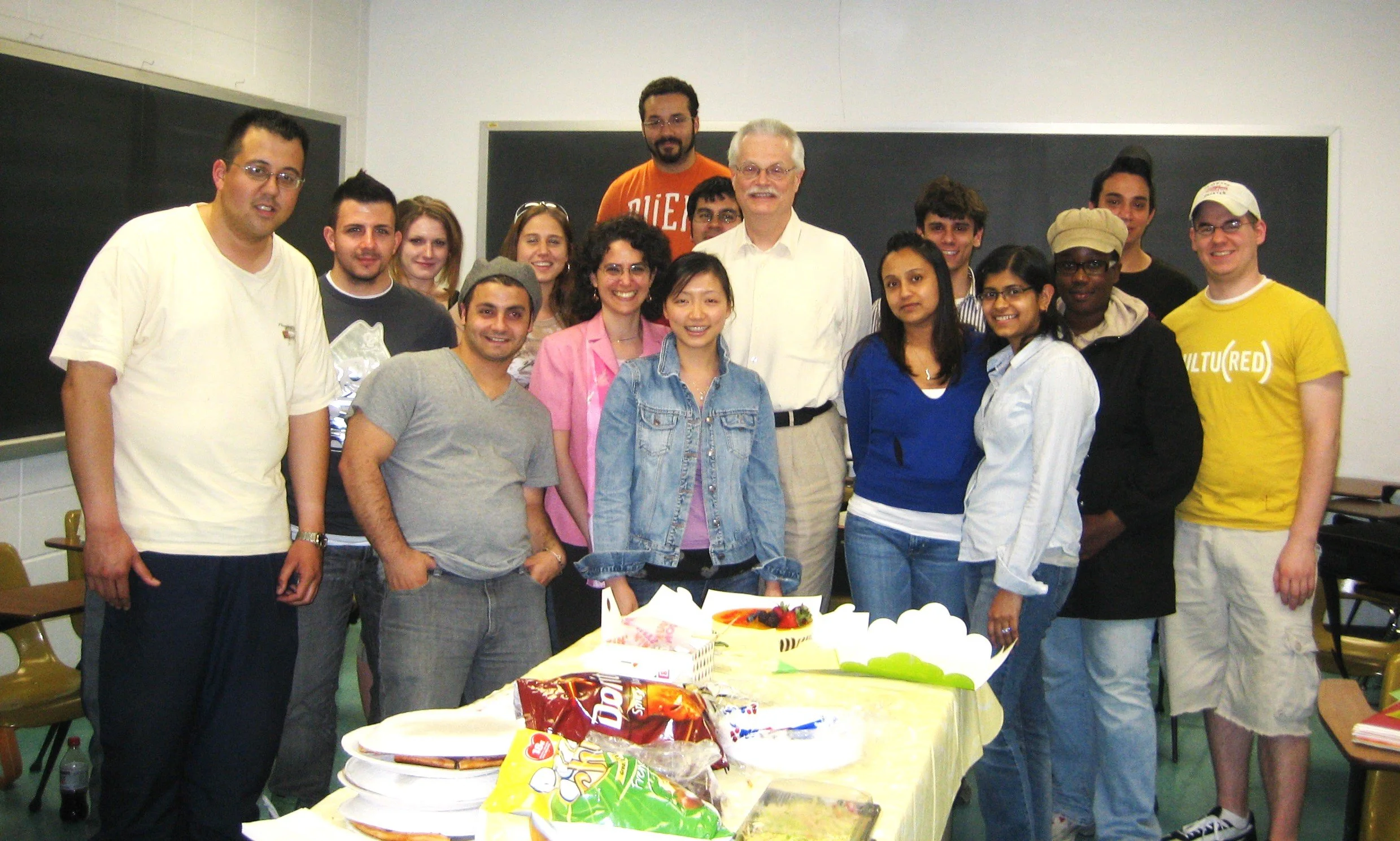
Dr. Sanjek with his final class at Queens College during his farewell party on 2008.
At that time, however, using researchers in their own immigrant communities was controversial. “There are many anthropological programs that forbid using field workers from the same ethnic group,” he explained.
The multi-ethnic approach brought a special richness to the study, Sanjek added. He recalled visiting a Hindu temple with then student and now head of the Asian American Center at Queens College, Madhulika Khandelwal. “Madhulika is a Hindu,” he said. “Non-Hindus wouldn’t have known what they were seeing or what questions to ask. She saw things that other people wouldn’t have seen.”
Fieldwork was focused in the Elmhurst/Corona district of Queens New York, the most ethnically diverse neighborhoods in the city. His team consisted of six researchers of Chinese, Korean, Dominican, Cuban, Indian, and African-American ethnicities working in their own neighborhoods along with Sanjek himself covering the established resident groups of European descent. Their efforts resulted in his book The Future of Us All (1998), which won many awards including the J. I. Staley Prize from the School for Advanced Research "…to a living author for a book that exemplifies outstanding scholarship and writing in anthropology." It also led to additional books by his six researchers on their own ethnic communities.
From the“Conclusion” of Roger Sanjek’s “The Future of Us All”
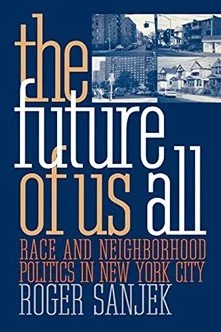
“The point is not to be color-blind; race, after all, is something one learns to see from childhood, and racial categories are in constant use. The goal, rather, should be to see racial identity as one among the many characteristics of every person and to appreciate the full range of human physical diversity in what always has been and is increasingly now an interconnected, color-full world…
“Race divides, but people can change. This book, beginning as an ethnography of one neighbor-hood’s majority-minority transition, became a study of the roots, and weeds, of local democracy ...
“Nothing is impossible if we believe that people can change.”
In 2003 he received a Guggenheim Fellowship in the "Anthropology and Cultural Studies" category for his 2009 Gray Panthers, a history as well as personal accounting of his own involvement in this advocacy group organized in Berkeley CA that grew into a national force focused on the rights of senior citizens.
From 1982 through 2003 he edited a 54-book series for Cornell University Press titled The Anthropology of Contemporary Issues Series.
He retired from teaching at Queens College CUNY in 2008 after a 36-year tenure. The day of his official retirement in 2008 was declared “Roger Sanjek Day” in Queens in a proclamation presented by Queens Borough President Helen Marshall.
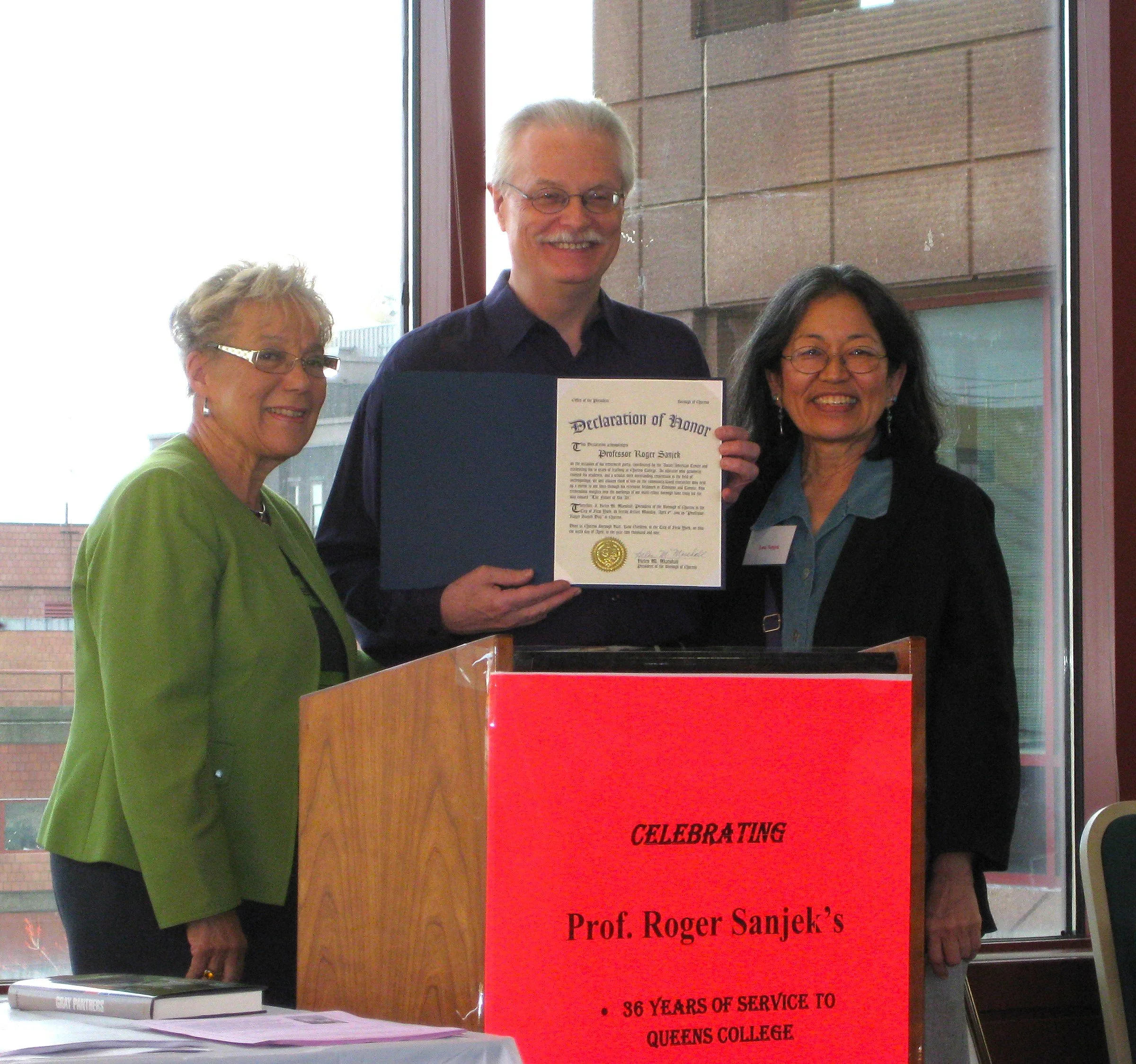
Queens Borough President Helen Marshall, Dr. Sanjek and Lani Sanjek.
Over the next ten years Dr. Sanjek remained active with the publication of Gray Panthers, eFieldnotes, Mutuality: Anthropology’s Changing Terms Of Engagement’ and Ethnography in Today's World: Color Full Before Color Blind; writing articles and reviews; lecturing; and public activism on behalf of both the Gray Panthers and the New York Statewide Senior Action Council advocacy group where his wife Lani served as president of the New York City chapter.
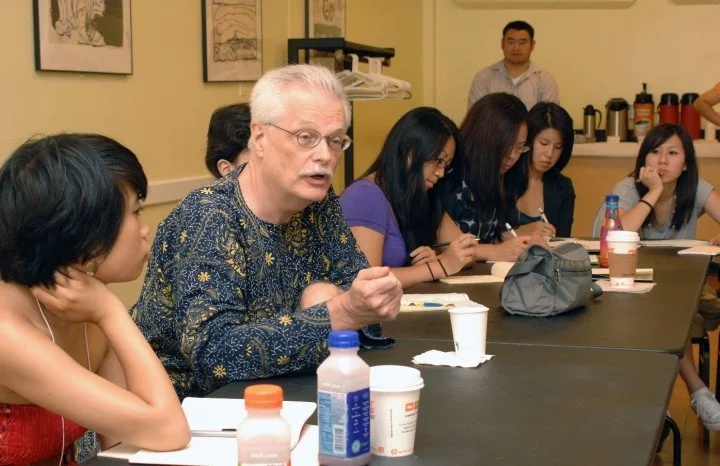
Dr. Sanjek addressing the students at the Queens College Asian American Center summer program examining ethnic diversity in the 2010 census.
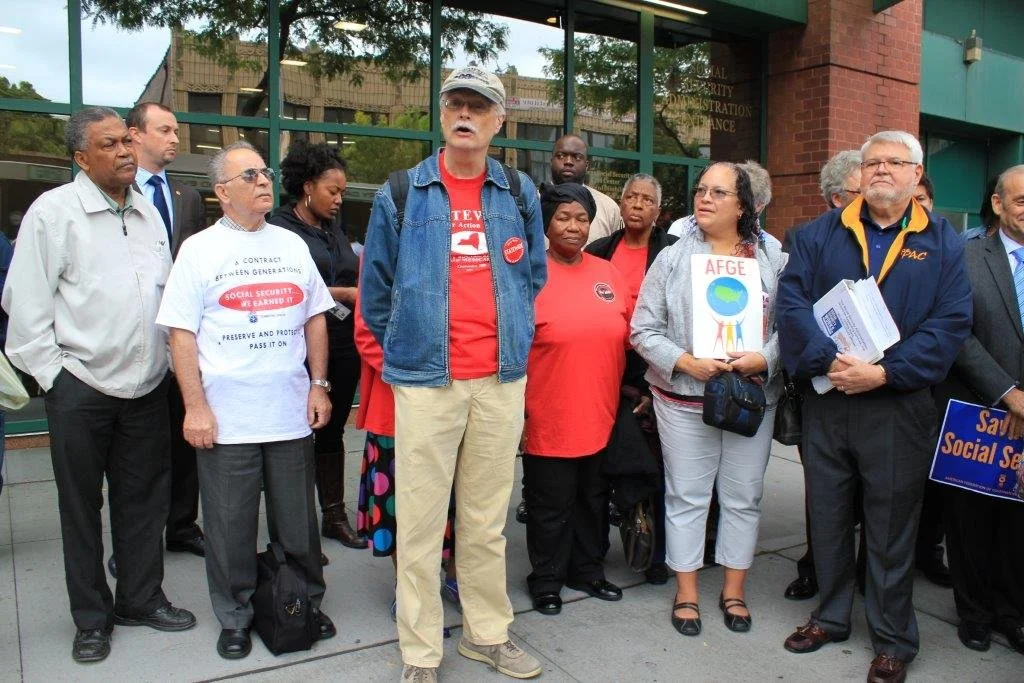
Dr. Sanjek in 2014 leading pro-Social Security increase rally at the Jamaica NY SSA administrative office
Most recently Roger and Lani have retired to her hometown of Honolulu, Hawaii and where her family still lives. He is presently working on a new book based on his fieldwork in Ghana over 55 years ago.
(For further information go to his Curriculum Vitae and Roger Sanjek Books)
Photo Credit: Courtesy of The Roger Sanjek Archive